
Stop Overpaying for Roaming: The Best eSIM Plans for Travel
You land in Tokyo, and within seconds of turning on your phone, you have data for maps and messaging because you installed an eSIM before departure. An eSIM is a digital SIM card embedded in your device, allowing you to activate a travel data plan without needing a physical plastic card. The primary benefit is instant connectivity in over 190 countries, eliminating the hassle of swapping SIMs or searching for local vendors. To use it, simply purchase a plan online, scan a QR code, and you are connected immediately upon arrival.
Why Global Roaming Is No Longer the Only Option
I remember scrambling to find a local SIM in a foreign airport, juggling passport and luggage, a hassle that made international roaming feel like a necessary evil. Now, global roaming is no longer the only option because eSIM technology lets me activate a local data plan directly on my phone before I even leave home. No more returning to find a bill loaded with per-megabyte fees. With an eSIM for travel, I simply scan a QR code or tap in a code, get connected the moment I land, and keep my primary number for calls. It turns the anxiety of connectivity into a seamless, pre-arranged step of packing, not a costly afterthought.
The hidden fees that catch most tourists off guard
Most tourists get blindsided by roaming fee surprises, like being charged per-minute for simply receiving a voicemail, or hit with daily “activation” fees even if they only send one text. Others land to find a flat $10 “connection” fee added before any data even flows. This is where an eSIM shines—you prepay a set amount with zero hidden charges. No daily tolls, no surprise voicemail penalties, just straightforward data.
Hidden fees like per-minute voicemail charges and daily connection tolls often catch tourists off guard, but eSIMs eliminate them with upfront pricing.
How cellular plans differ between regions and carriers
Regional carriers structure plans around local usage, meaning prepaid data in Asia is often cheaper and more generous than in North America or Europe, where western carriers typically bundle smaller high-speed allowances with slower unlimited throttling. With eSIM, you can purchase a local carrier’s plan directly—like grabbing a Japanese carrier’s 30GB high-speed package for a fraction of a U.S. plan’s cost. This bypasses your home carrier’s roaming markups entirely. Cellular plan cost disparities between regions make eSIM the clear choice for avoiding inflated roaming fees. Question: How do plan differences affect my travel strategy? Answer: You select a local eSIM plan from the region you visit, so a traveler headed to Thailand can buy a carrier’s cheap local data pack instead of paying your U.S. carrier’s per-day roaming charge—saving money and often getting faster speeds.
What Sets a Digital SIM Apart on the Road
What sets a digital SIM apart on the road is the instant activation that eliminates hunting for local vendors. With an eSIM for travel, you switch networks in seconds via a QR code, avoiding physical card swaps that risk losing the tiny chip. You can pre-load plans before departure, ensuring data the moment you land without roaming delays. While driving across borders, a digital SIM allows seamless profile toggling between regional carriers, maintaining connectivity without changing hardware. This flexibility lets you keep your primary line active for calls while the eSIM handles cheap data, a crucial advantage over traditional SIMs that force either-or choices during road trips.
Instant activation without visiting a store
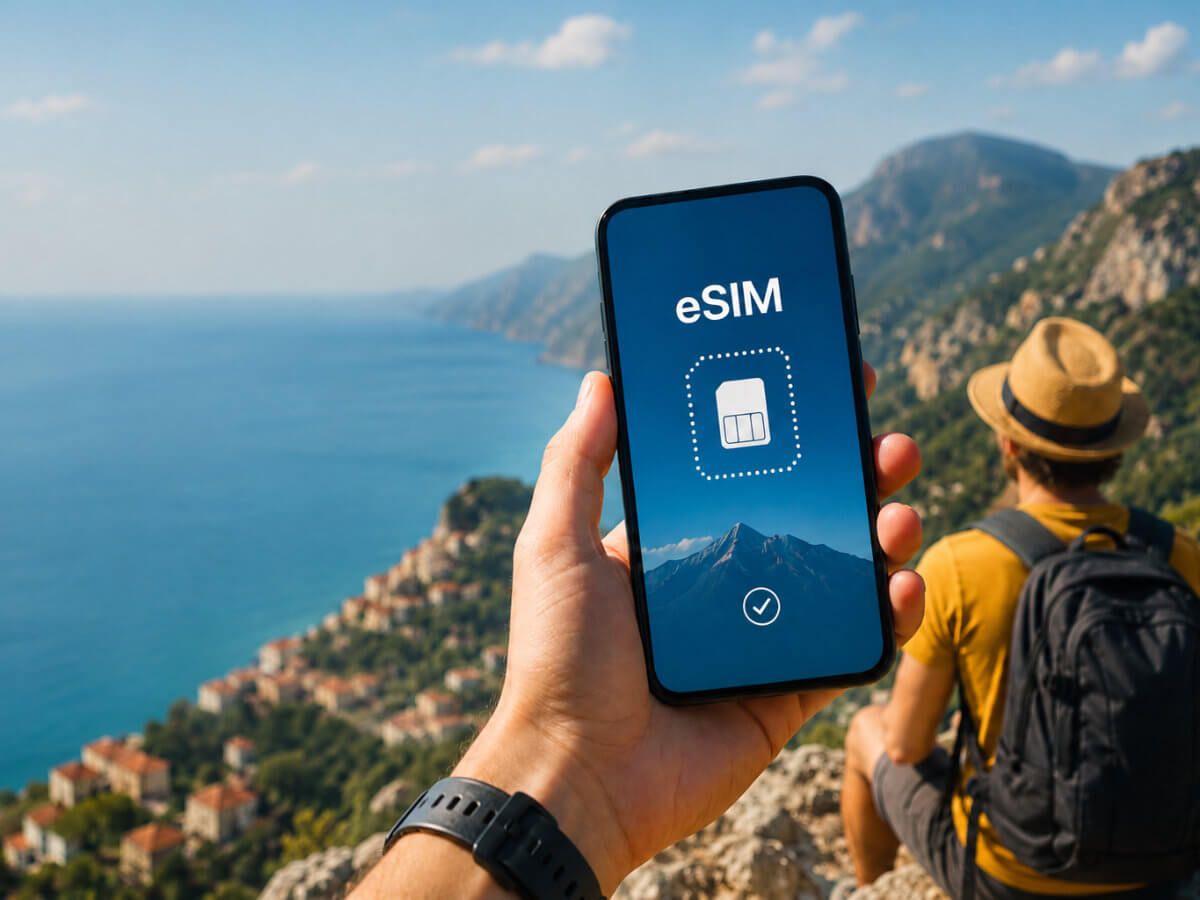
Instant activation without visiting a store means travelers can buy and connect to a local data plan from anywhere—an airport lounge, a hotel room, or even before departure. There is no trip to a physical shop for a physical SIM card, no queuing, and no need to present identification documents at a counter. Instead, you simply scan a QR code or install a profile via an app, and service begins within minutes. This is crucial when you arrive in a foreign country late at night or in a remote location with no nearby retailer. Immediate connectivity on arrival erases the barrier of finding a store during odd hours.
Instant activation without visiting a store lets travelers obtain mobile data within minutes of landing, directly from their mobile device.
Keeping your primary number active while abroad
A core advantage of a travel eSIM is the ability to keep your primary number active. Instead of physically swapping out your home SIM, which deactivates your number, an eSIM allows you to install a local data plan while your primary SIM remains enabled for calls and texts. This is critical for receiving two-factor authentication codes or staying reachable on your usual line. You simply configure the primary line for voice/SMS only and the eSIM for data, avoiding missed messages and maintaining your digital identity without incurring expensive roaming fees on the primary number. This setup ensures continuous primary number access while abroad.
Choosing the Right Data Package for Your Trip
When choosing the right data package for your trip, first estimate your daily usage; for navigation and messaging, a 1GB plan often suffices, but streaming video demands far more. Prioritize regional eSIM for travel packs if hopping between countries, as they are cheaper than individual national plans. Check the validity period against your itinerary to avoid unused data—purchase a plan that activates immediately upon arrival, not at the time of purchase. For short trips, a 7-day unlimited plan offers simplicity, while longer stays benefit from tiered data caps to save money. Always verify network coverage for your destinations within the eSIM provider’s description.
Comparing regional plans versus country-specific cards
When weighing regional plans versus country-specific cards, consider your itinerary’s logic. A regional plan, covering multiple nations like Europe or Asia, offers seamless connectivity if you hop borders frequently, saving you from swapping eSIMs daily. Conversely, a country-specific card usually delivers faster speeds and cheaper data for deep dives into one location. This trade-off rewards multi-stop travelers while penalizing those lingering in a single hub with wasteful coverage. For cross-country road trips, regional eSIM flexibility eliminates re-setup hassle; for a week in one city, buying local often unlocks more gigabytes for your budget. Match the geography to your movement, not your wishful thinking.
| Scenario | Regional Plan | Country-Specific Card |
| Multi-country tour (e.g., 5 countries in 10 days) | Best—single install, continuous connectivity | Poor—requires repeated purchases and manual swaps |
| Stationary trip (e.g., 2 weeks in Japan only) | Weak—pays for unused coverage; often throttled | Best—targeted speed and price per GB |
Understanding data caps, speeds, and fair usage policies
When evaluating travel eSIMs, understanding data caps, speeds, and fair usage policies is critical to avoiding service disruption. A data cap defines your total high-speed allowance; once exceeded, providers typically throttle your connection to near 2G or 3G speeds, making streaming or navigation impractical. Fair usage policies (FUPs) apply to “unlimited” plans, imposing a soft cap—often around 500MB to 1GB per day—after which speeds drop drastically, regardless of remaining validity. Always verify whether your eSIM operates on a 4G/LTE or 5G network, as advertised speeds may reduce under network congestion. Checking these specifics before purchase ensures you select a package that matches your actual usage habits, preventing unexpected slowdowns during your trip.
Devices That Support This Technology
Most modern smartphones from the last few years, including Apple iPhone XS and newer, Google Pixel 3 and later, and Samsung Galaxy S20 and above, come with built-in eSIM slots. For travel, this means you can instantly activate a local data plan before you even board your flight, without hunting for a physical nano-SIM. Many newer mid-range Android models and even the latest iPad Pros and Apple Watches also support it, giving you a connected device while roaming.
Always check your device’s IMEI against your chosen travel eSIM provider’s compatibility list before purchasing a plan, as carrier locks or regional firmware can still block functionality.
If your phone lacks eSIM hardware, you remain tethered to physical cards—making a device upgrade the single most effective step for on-the-go connectivity.
Checking phone compatibility before departure
Before you jet off, check your phone’s eSIM compatibility to avoid a data dead-end. Most newer phones, like iPhones from the XR onward and recent Pixel or Samsung models, support eSIMs. Head into your phone’s settings, tap “Cellular” or “Mobile Data,” and look for an “Add eSIM” option—that confirms you’re good to go. If your phone is carrier-locked, it might block new eSIMs, so verify that too. Here’s a quick sequence to follow:
- Open your phone’s main settings menu.
- Find the location for SIM or mobile network settings.
- Check if an “Add eSIM” or “Download eSIM” button appears.
- Contact your carrier if the option is hidden or grayed out.
Differences between dual SIM and single SIM setups
For travel, a dual SIM setup lets you keep your home SIM active for banking codes while inserting a travel eSIM for data, avoiding the single SIM’s need to physically swap cards. Key differences in device support dictate flexibility: dual SIM phones allow both lines live simultaneously, whereas single SIM eSIM-only devices require disabling your primary number. This distinction matters more for travelers who rely on constant access to two-factor authentication from their home carrier.
- Dual SIM: Store a physical home SIM and a travel eSIM, using one for calls and the other for data without any removal.
- Single SIM eSIM: You must choose between your home profile and the travel profile, switching manually in settings.
- Dual SIM: Can assign default lines for calls, messages, and data independently.
- Single SIM: Forces all traffic through the active eSIM profile, potentially missing calls from your home number.
How to Install and Activate Before You Fly
To install and activate your travel eSIM before you fly, first purchase a plan from a compatible provider. Immediately scan the QR code sent to your email or download the provider’s app to install the eSIM profile on your device. Ensure you label the line (e.g., “Travel Data”) in your settings. Activate it at home by toggling it on in your cellular settings, even while you still have Wi-Fi; it will auto-connect upon arrival. A common hurdle: Why won’t it activate until I land? Because most plans require the first connection on a local network to start the timer. Verify your APN settings remain correct under “Cellular Data Network” to avoid surprises.
Step-by-step setup for iOS and Android
For iOS users, open **Settings > Cellular > Add eSIM**. Scan the QR code provided by your travel eSIM vendor, label the plan (e.g., “Spain Data”), and set it as your default for mobile data. On Android, navigate to **Settings > Connections > SIM Card Manager > Add Mobile Plan**. Scan the QR code, assign a name, and disable your primary SIM for roaming to avoid accidental charges. Activate the travel eSIM only at your destination to start billing correctly. What if the QR code fails to scan? Most carriers offer a manual input option: locate the SM‑DP+ address and activation code from your purchase confirmation email, and enter them under “Enter details manually” on both platforms.
What to do if activation fails at your destination
If activation fails after landing, don’t panic. First, toggle airplane mode off and on to force a network refresh. Manually select your provider in your phone’s cellular settings instead of relying on automatic selection. Double-check you’re scanning the correct QR code from your purchase email. If it still doesn’t work, switch to the eSIM’s secondary APN profile (often labeled with a number like “APN 2”) in your data settings. As a last resort, connect to local Wi-Fi and contact your eSIM provider’s support via their app or WhatsApp—they can push a fresh configuration remotely. Always download the eSIM’s installation guide before you travel so you have offline troubleshooting steps.
Activation fails? Toggle airplane mode, manually select your network, try the secondary APN, or contact support via Wi-Fi.
Managing Connectivity Across Multiple Countries
The train from Milan to Zurich slipped through the Alps, and my phone didn’t flinch. With an eSIM managing connectivity across multiple countries, I’d set it to auto-select local networks as borders blurred. No frantic SIM swaps or hunting for Wi-Fi codes; the connection simply seamlessly handed off from Italy’s TIM to Swisscom mid-tunnel. Once, in a Vienna café, the data slowed to a crawl—until I realized the eSIM’s dashboard let me manually lock onto a stronger local carrier with a single tap. That small control, toggling between redundant profiles, turned a patchy roaming session into reliable, background quiet. For a week across three countries, my only task was to unplug, not troubleshoot.
Automatic carrier switching vs manual selection
For travelers, automatic carrier switching offers seamless connectivity by selecting the strongest local network without user intervention, perfect for avoiding dead zones while moving between countries. In contrast, manual selection gives you full control, letting you pin a preferred home network to ensure consistent speeds or avoid weaker providers. However, this demands attention; forgetting to switch upon arrival can leave you disconnected. While auto-switching is effortless for most trips, manual selection remains vital when you need predictable performance in specific regions.

| Automatic Switching | Manual Selection |
|---|---|
| Hands-free operation, ideal for frequent border crossings | Requires user action per location change |
| May briefly connect to slower networks | Guarantees connection to your chosen carrier |
Avoiding accidental charges on your home plan
The most critical step in avoiding accidental charges on your home plan is to disable automatic network selection on your primary SIM before traveling. Immediately upon landing, switch your device to airplane mode, then manually turn off data roaming and cellular data for your home line. Keep that line active only for receiving China eSIM SMS if absolutely necessary, and ensure your eSIM profile for the destination is set as the default for data. Any data or call inadvertently routed through your home carrier can trigger exorbitant roaming fees, so confirm these settings are locked before moving through customs.
Top Providers for Frequent Travelers
For frequent travelers, Airalo and Holafly are top choices because they offer global eSIMs with instant activation. Airalo works well for hopping between countries, letting you top up effortlessly via its app. Holafly is ideal for data-heavy trips, as it provides unlimited data plans across many regions, so you never stress about running out. Both allow you to keep your primary SIM active for calls, while the eSIM handles data. Jetpac is another solid pick for multi-destination itineraries, offering bundled regional plans. Their apps make switching between profiles simple, avoiding physical SIM swaps. Ultimately, these providers save you from hunting for local SIMs or buying pricey roaming passes.
Which services offer the best coverage in Asia
For travelers hitting multiple spots, best eSIM coverage in Asia often comes from Airalo’s regional Asia plan, which connects smoothly in Japan, Thailand, and South Korea. Holafly’s unlimited data excels in India and Indonesia, while Nomad offers strong local networks in Vietnam and the Philippines. Your choice really depends on whether you prioritize speed across big cities or reliability in remote areas like Bali’s beaches.

- Airalo works great for bouncing between Singapore, Malaysia, and Hong Kong.
- Holafly is solid for unlimited data in China and Taiwan.
- Nomad provides affordable top-ups for short Cambodia stays.
Reliable options for Europe, North America, and Oceania
For European travel, Airalo’s regional “Europe” eSIM and Orange Holiday Europe provide reliable options for Europe, North America, and Oceania with stable LTE on networks like Vodafone and Telefónica. In North America, T-Mobile and AT&T-based eSIMs from Holafly offer unlimited data for the USA and Canada, while Mexico benefits from Telcel coverage. For Oceania, providers like Jetpac and Ubigi deliver strong speeds on Telstra and Spark in Australia and New Zealand. To ensure seamless switching:
- Activate the European eSIM only upon arrival in the EU to avoid early billing.
- Purchase a separate North American eSIM with APN settings pre-configured for instant activation.
- Choose a regional Oceania plan covering both Australia and New Zealand to avoid dual purchases.
Tips for Stretching Your Data Allowance
When your eSIM for travel grants a modest data pool, every megabyte feels precious. I learned to preload maps and translation dictionaries over hotel Wi-Fi before stepping out, killing the background refresh of email and social apps. Streaming a single song can devour more than a day’s browsing, so I download entire playlists and podcasts while connected to a stable network, then listen offline. Using a lightweight browser that strips images and ads turned my three-gigabyte allotment into a two-week lifeline. I also switched messaging apps to “low-data mode,” which squeezed hours of texting from mere kilobytes. That careful, deliberate rationing transformed a ten-gig eSIM from a fleeting convenience into a steady companion across five countries.
Using offline maps and cached content
Using offline maps is a primary tactic for stretching your travel eSIM data. Before departure, download detailed maps for your destinations via apps like Google Maps or Maps.me, which function without internet. Cache frequently visited websites, itineraries, and translation databases while on Wi-Fi. Pre-loading cached content eliminates data usage during navigation and lookup. Even reviewing cached maps in airplane mode ensures you do not accidentally stream traffic data. This strategy preserves your eSIM allowance solely for essential real-time tasks like messaging or booking confirmations.
Offline maps and cached content eliminate data consumption for navigation and reference, directly preserving your travel eSIM allowance.

Disabling background app refresh on the go
Disabling background app refresh on the go is a precise method for conserving your travel eSIM data. When you enable this setting, apps stop silently updating content—like fetching new emails or social feeds—until you open them. For maximum control, follow this sequence: Disable background app refresh selectively in your device settings.
- Navigate to Settings > General > Background App Refresh.
- Toggle it off for non-essential apps (e.g., games, shopping).
- Keep it enabled only for navigation or messaging apps you actively use.
This eliminates hidden data drain while you roam, ensuring your allowance lasts for critical tasks like maps or translation.
Common Setup Mistakes and How to Fix Them
A frequent setup mistake is installing the eSIM before departure, which can cause immediate activation and waste your travel days. Fix this by waiting until you arrive at your destination to scan the QR code. Another common error is failing to enable data roaming for the new eSIM line while keeping your primary line disabled to avoid international charges. Always designate the travel eSIM as your default for mobile data in your cellular settings. Finally, forgetting to manually select the correct APN settings is a typical issue; locate the exact APN from your eSIM provider’s confirmation email and input it precisely to restore connectivity immediately.
Why your phone might show “No Service”
A “No Service” message often stems from incorrect APN configuration for your travel eSIM. The phone cannot connect to the local network because the Access Point Name, which routes data, isn’t set to match the eSIM carrier’s profile. Another common cause is that the eSIM line is disabled in your device’s mobile data or cellular settings, so the phone ignores the remote network entirely. Manually verify the eSIM profile details by tapping on the installed plan under cellular settings. If roaming is toggled off for that specific line, the phone will also fail to establish a connection and display “No Service.”
Restoring your original SIM after the trip
One common mistake after using an eSIM for travel is forgetting to restore your original SIM, which can cause missed calls or texts back home. To fix this, simply go into your phone’s cellular settings and re-enable your physical SIM or primary line, usually by toggling it back on or moving it to the top of the data list. Many travelers also forget to remove the travel eSIM to avoid confusion, so delete that profile after your trip. This step is crucial for restoring your original SIM after the trip without needing to buy a new plan or contact your carrier.
- Re-enable your primary SIM line in mobile network settings.
- Delete the travel eSIM profile to prevent auto-selection errors.
- Check that your voicemail and SMS services are active again.
- Restart your phone to finalize the switch back properly.
When a Physical SIM Still Makes Sense
A physical SIM still makes sense for travel when your destination has limited or no eSIM-compatible carriers, ensuring you can connect immediately upon arrival. It also remains practical if you frequently swap phones mid-trip, avoiding the hassle of transferring eSIM profiles between devices. For remote areas, a physical SIM can be swapped into a basic backup phone with better battery life or signal reception. However, tying your number to a single physical SIM can complicate switching plans if a local offer appears en route. Finally, if your home carrier charges exorbitant fees for eSIM activation, a prepaid physical SIM at the airport provides a cheaper, instant solution without account changes. This makes physical SIMs a reliable fallback for unpredictable travel scenarios.
Long-term stays in remote areas
For long-term stays in remote areas, a physical SIM card provides crucial network stability that many eSIMs cannot guarantee. Unlike digital profiles reliant on a single roaming partner, a local physical SIM connects directly to a regional tower, ensuring consistent service for months in areas with sparse coverage. This avoids interruptions from eSIM re-provisioning delays or server outages in off-grid locations. A physical SIM also allows you to physically swap providers if one fails, a safety net absent from most eSIMs. Reliable connectivity in isolation depends on this hardware-based fallback.
A physical SIM ensures uninterrupted local network access during prolonged stays in remote areas, bypassing eSIM roaming risks.
Backup options for emergencies
A physical SIM serves as a reliable fallback when an eSIM fails during travel. If network registration errors or device corruption prevent eSIM activation, swapping to a pre-installed physical SIM restores connectivity instantly. This backup is critical for emergencies like navigating to a hospital or contacting local authorities without Wi-Fi. Carrying an inactive physical SIM from your home carrier or a prepaid global SIM ensures you never lose access to essential calls. Emergency eSIM backup should always pair with a physical card for zero-dependency coverage.
A physical SIM provides a failsafe connection when eSIM technology fails, ensuring uninterrupted access to emergency services and navigation during travel crises.

 By admin